Analytics and Switchboards
Analytics holds the trends: calls by outcome, answer rate, busiest hours, how fast missed callers were got back to, how long phones ring before someone answers, when calls go unanswered by weekday and hour, and Talk's call-quality scores. Everything on it is counted only over the lines you may see, so two people can open it and rightly get different figures.
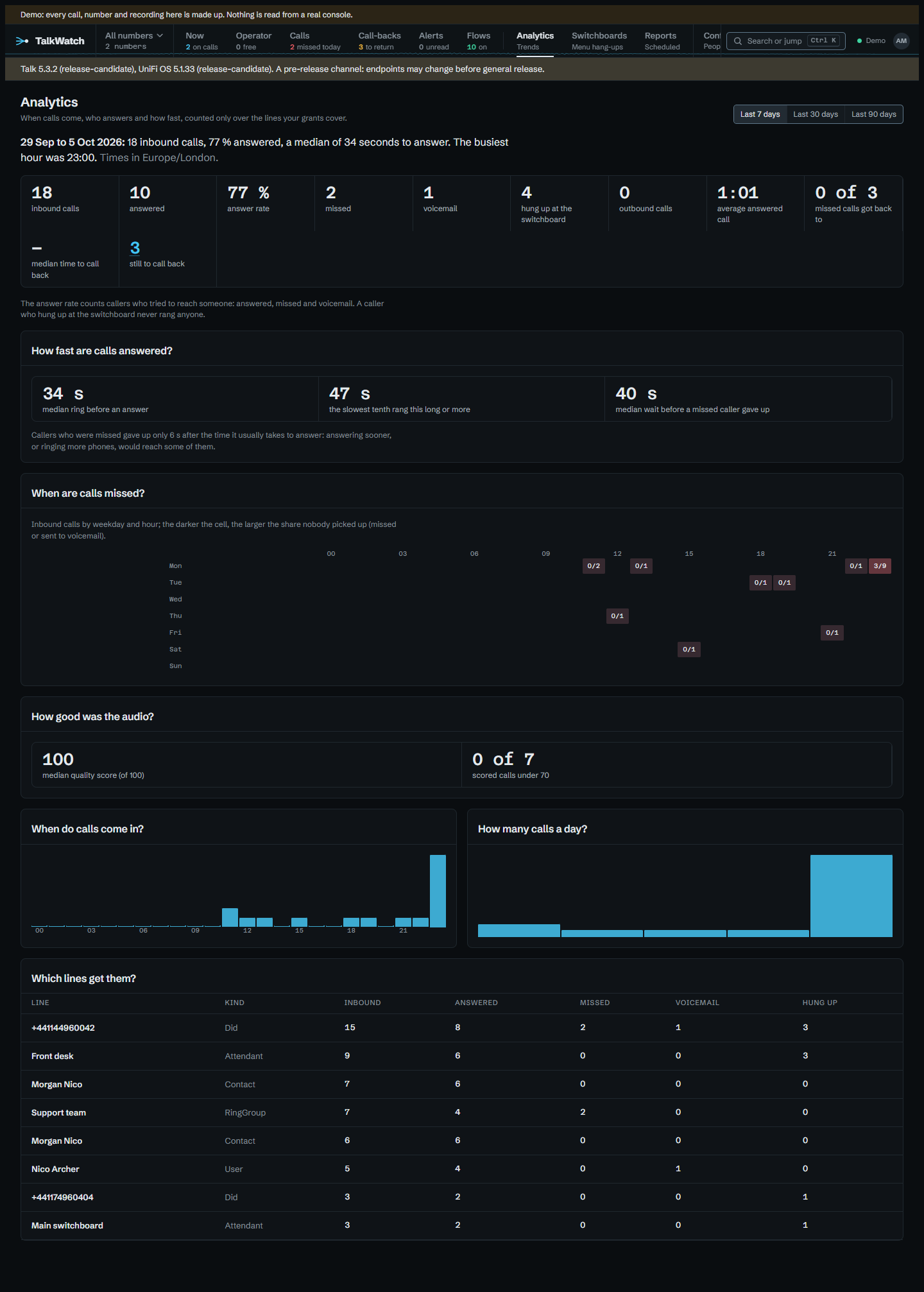
The period
It opens on the last 7 days, with Last 30 days and Last 90 days beside it. Any other period goes in the address, as whole days in the site's time zone, up to 92 at once:
/dashboard?days=30/dashboard?from=2026-09-01&to=2026-09-30, September
A sentence at the top says it in words, 1 Sep to 30 Sep 2026: 412 inbound calls, 81% answered, a median of 14 seconds to answer. The busiest hour was 10:00, which is usually the line someone's after when they open the page.
The figures
Inbound calls, how many were answered, missed, left as voicemail or hung up at the switchboard, outbound calls and the average answered call, then missed calls got back to, the median time to call back, and how many are still to call back, which links to the list.
The answer rate counts callers who tried to reach someone: answered, missed and voicemail. A caller who hung up at the switchboard never rang anyone, so counting them would make the rate a measure of the greeting rather than the people answering. They're counted on Switchboards instead.
How fast are calls answered?
Three figures: the median ring before an answer, how long the slowest tenth rang, and the median wait before a missed caller gave up.

The last two together are the useful part. When missed callers give up only a few seconds after calls are usually answered, the page says so: those callers were nearly reached, and answering a little sooner, or ringing more phones, would reach some of them. When they give up well before, it's the greeting or the queue that's losing them, not the people answering.
When are calls missed?
Inbound calls by weekday and hour, each cell the calls nobody picked up out of those that came in. The darker the cell, the larger the share missed or sent to voicemail.
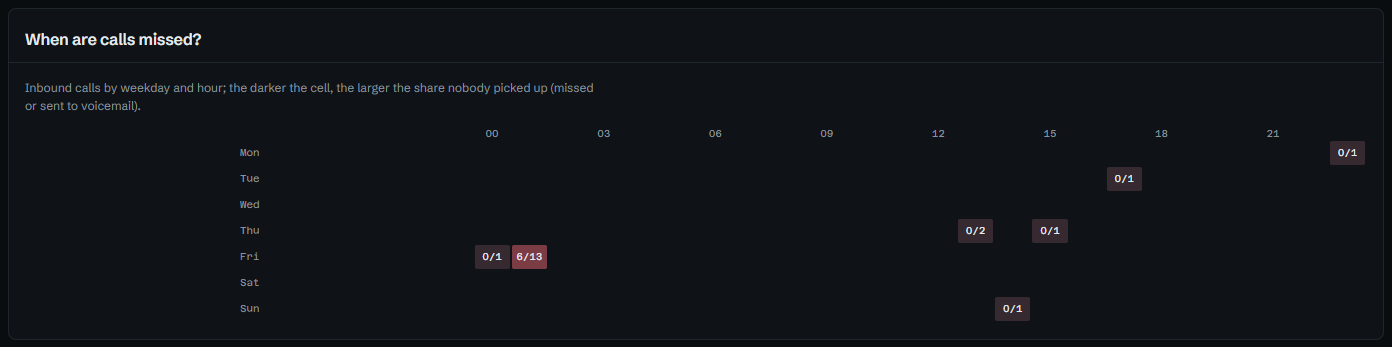
It's the grid to plan cover by: a dark noon is lunch with nobody minding the phones, and a dark first hour on Monday is the weekend arriving at once.
How good was the audio?
Talk scores each call's audio out of 100. The median, how many scored under 70, and the worst calls, each a link to the call so the recording can be heard.
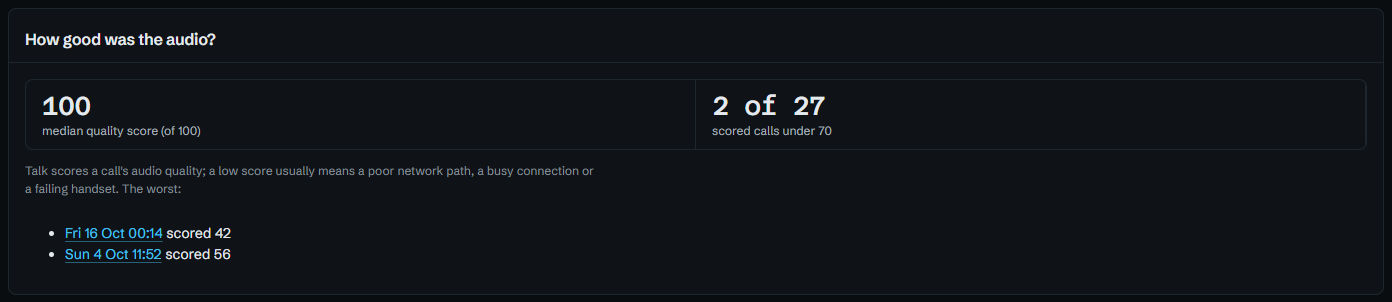
A low score usually means a poor network path, a busy connection or a failing handset. Under 70 is where TalkWatch counts a call as poor: it's amber in the call log, and it's what the Poor call quality alert fires on.
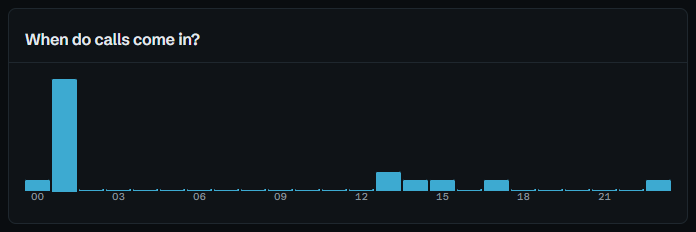
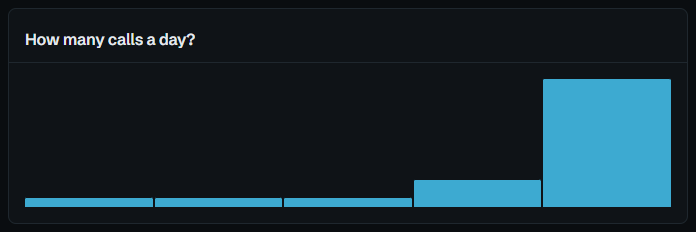
When do calls come in, and how many a day?
Calls by hour of the day, and by day across the period.
Which lines get them?
Each number, person, switchboard and ring group, with its inbound calls and how many were answered, missed, left as voicemail or hung up. A call counts on every line it passed, so the rows add up to more than the total.
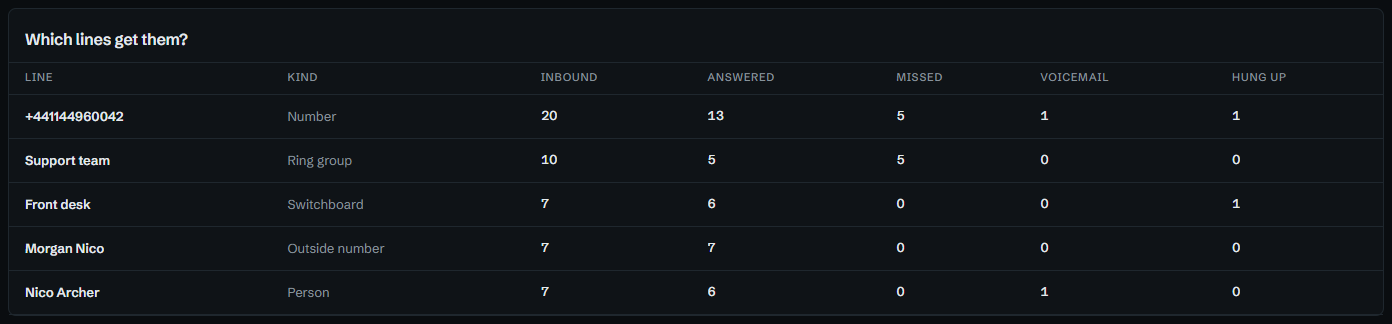
To see one line's calls, search for it with Ctrl+K: a line in the results opens the call log narrowed to it.
Switchboards
Switchboards shows each auto-attendant over the last 30 days (or 7, or 90,
with ?days=): how many callers reached it, how long its greeting runs, how
many hung up during the greeting and how long they lasted, and what the rest
reached: answered, missed or voicemail.
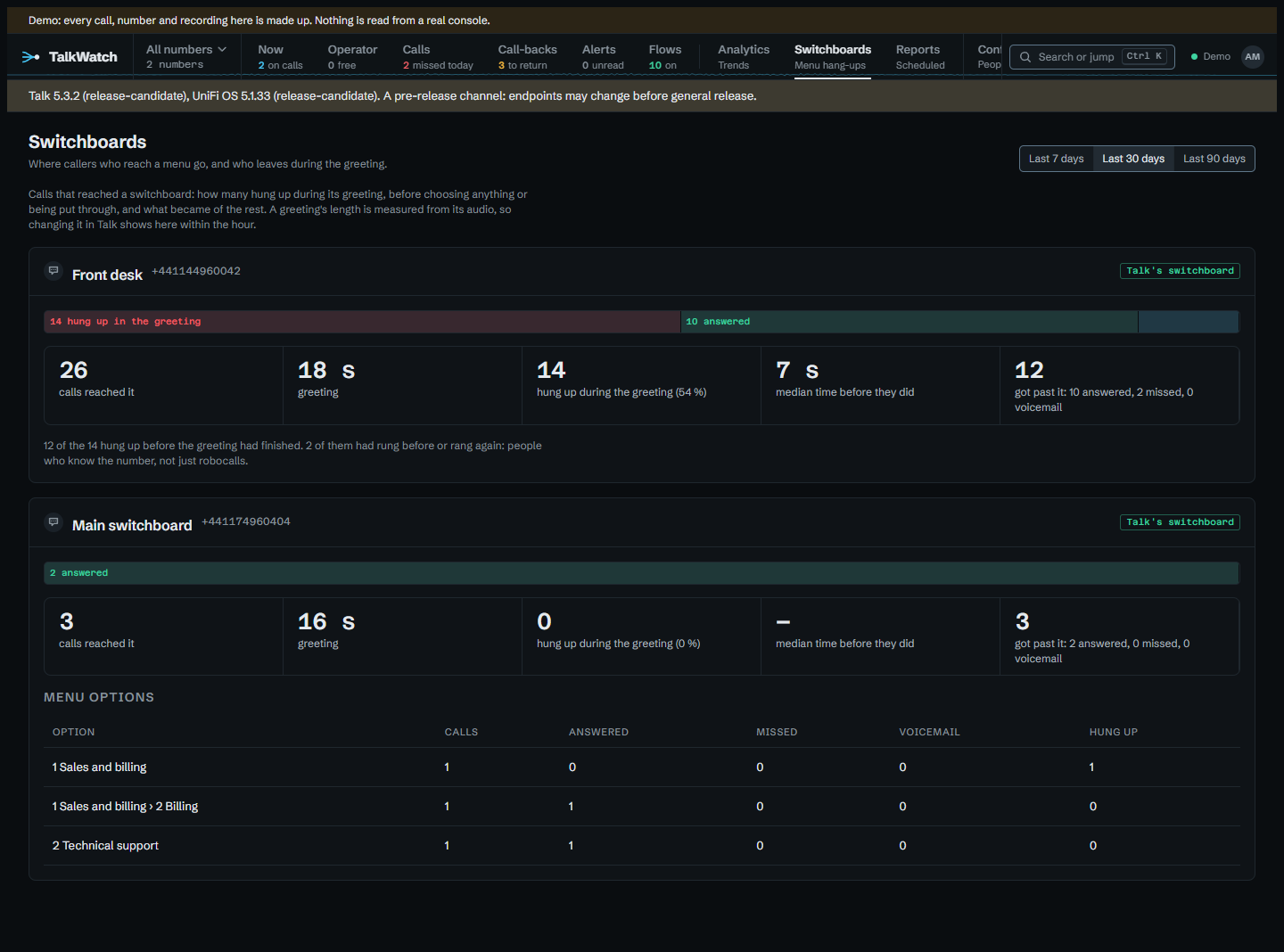
- The greeting's length is measured from its audio, so a change made in Talk shows here within the hour.
- Hung up during the greeting comes with how many of those callers had rung before or rang again: people who know the number, not just robocalls.
- Menu options lists each option with its calls and what they led to, and a row for callers who chose nothing. An option that is switched off, has no audio or goes nowhere says so beside its name.
- Opening hours: where an option, or the switchboard itself, splits by opening hours, a row under it says how its calls divided between the branches. Talk doesn't log which branch a call took, so each call's branch is worked out from its time and the branches' hours as they were then, from the setup TalkWatch kept at the time. These rows are marked inferred. A call that came before TalkWatch first kept the setup is placed by the first one kept. A call whose branch can't be said, because holidays were on with dates TalkWatch can't read, is counted as Branch not known.
- What's wrong with its setup shows above the figures: a greeting with no audio, a menu or branch that goes nowhere, dialling by extension that reaches nobody. A switchboard no call reached in the period still appears when it has one of these, because it may be why nobody got through.
If most hang-ups happen in the first fifteen seconds, that's the greeting to shorten. See Callers who give up at the switchboard for reading it, and the alert that goes with it.
The same figures elsewhere
- Reports carry the figures by email on a schedule, against the period before. See Reports.
- The API's
/api/v1/statsreturns them for any whole days, up to 92. See Export and API.