Using TalkWatch's data elsewhere
TalkWatch's pages are for people. For everything else, a helpdesk that should open a ticket for a voicemail, a spreadsheet the accounts team already keeps, a Grafana board on the wall, there are three ways out, each going through the same access as the pages: a webhook pushes alerts as they happen, the API reads calls and figures, and an export hands over a date range in one file.
Webhooks: alerts as they happen
A Webhook channel, under Configure → Alert channels, POSTs each alert a flow sends it as JSON. Give it a signing secret and every body is signed, so the receiver can check it came from TalkWatch:
| Header | Holds |
|---|---|
X-TalkWatch-Signature |
sha256= and the HMAC-SHA256 of the body, with the secret, as lowercase hex |
X-TalkWatch-Event |
the alert's type (MissedCall, Voicemail and so on), Acknowledged for the follow-up when someone acknowledges, or Bundle |
X-TalkWatch-Delivery |
the delivery's id, the same on every retry, so a receiver can drop repeats |
Check the signature over the exact bytes received, before parsing them. In Python:
import hashlib, hmac

def from_talkwatch(body: bytes, header: str, secret: str) -> bool:
    expected = "sha256=" + hmac.new(secret.encode(), body, hashlib.sha256).hexdigest()
    return hmac.compare_digest(expected, header or "")
And in Node:
import { createHmac, timingSafeEqual } from 'node:crypto';

function fromTalkWatch(body, header, secret) {
  const expected = Buffer.from('sha256=' + createHmac('sha256', secret).update(body).digest('hex'));
  const given = Buffer.from(header ?? '');
  return given.length === expected.length && timingSafeEqual(given, expected);
}
The body carries the call, links to acknowledge or snooze the alert, and, when the flow's notify step asks for them, Talk's summary, the transcript and a link to the voicemail. The full shape is under Channels. Deliveries that fail are retried after 1, 5 and 15 minutes, then an hour, then every 6 hours, and given up after 8 tries, so a receiver that's down for a restart misses nothing.
Send test on the channel sends one straight away, to check the receiver before a real alert depends on it.
The API: calls and figures on request
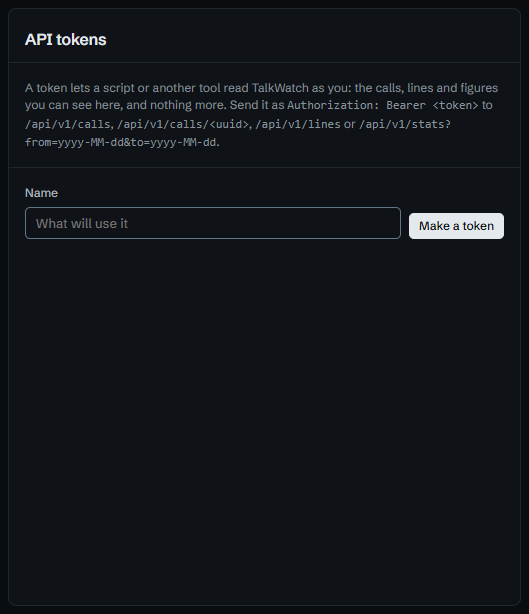
Make a token on your Account page. It's shown once; TalkWatch keeps only a hash of it, so a lost one is revoked and replaced, not read back. It acts as you: it reads exactly what you could read signed in, and nothing is writable through it.
# This week's calls, newest first, up to 500 a page.
curl -H "Authorization: Bearer $TOKEN" \
  "https://talkwatch.example/api/v1/calls?since=2026-09-28T00:00:00Z&pageSize=500"

# September's figures, as the Analytics page counts them.
curl -H "Authorization: Bearer $TOKEN" \
  "https://talkwatch.example/api/v1/stats?from=2026-09-01&to=2026-09-30"
/api/v1/stats returns the inbound count, answer rate, average answered call,
calls by outcome, by hour, by day and by line, for up to 92 whole days in the
site's time zone: enough for a wall board, or a monthly figure in a spreadsheet
that updates itself. Every endpoint is listed under Export and
API.
Exports: a date range in one file
Export on Calls downloads up to a year of calls as CSV or Parquet, with one row a call:
uuid, time_utc, time_local, direction, outcome, status, from,
from_e164, caller_name, to, to_e164, answered_by, duration_seconds,
has_recording
outcome is TalkWatch's, worked out from what happened to the call (Answered,
Missed, Voicemail, HungUpAtSwitchboard, OutsideVoicemail,
OutsideMissed, Outbound and a few rarer ones), not Talk's status, which is
accepted for nearly everything. That column is most of the reason to export
from here rather than from Talk.
The CSV opens in Excel as it is. Parquet keeps the types, so nothing has to be parsed, and suits DuckDB:
-- Missed calls by weekday, from an export.
SELECT dayname(time_utc) AS day, count(*) AS missed
FROM 'talkwatch-calls-2026-09-01-to-2026-09-30.parquet'
WHERE direction = 'in' AND outcome IN ('Missed', 'OutsideMissed')
GROUP BY day ORDER BY missed DESC;
Every export goes in the audit log, with who took it and what it covered.
What none of them do
None of them change anything in Talk or TalkWatch: the API is read-only, and a webhook only receives. Nor do they reach further than the person behind them. A token or an export sees only that person's lines, and a channel given to one person hears only of their calls, whatever a flow says.
See also
- Export and API.
- Alerts → Channels, for ntfy, email and Telegram.
- Traces and metrics, for TalkWatch's own health.